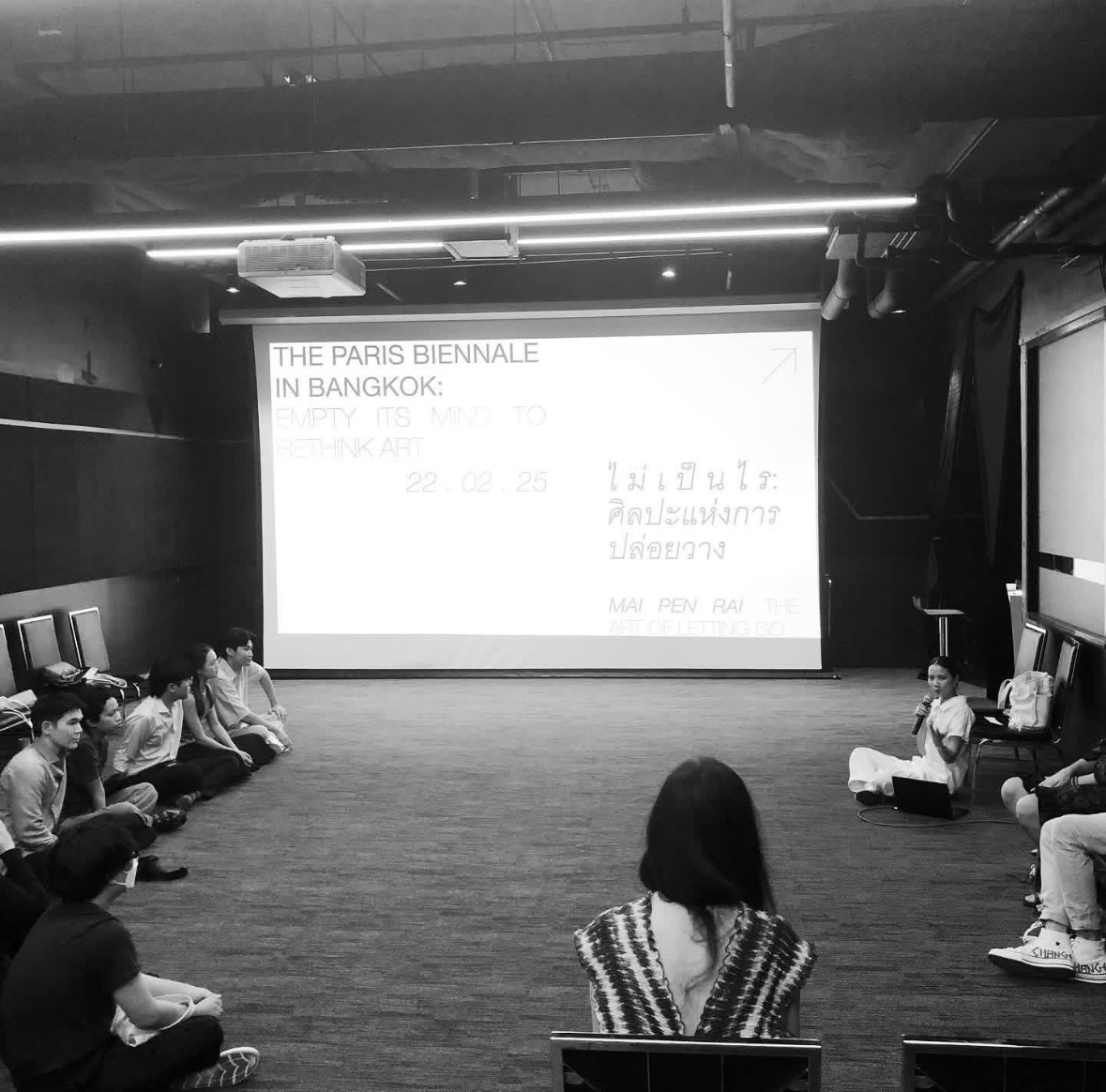
The Biennale de Paris in Thailand
Bangkok
21–28 February 2025
Creating a Void to Rethink Art
Founded in 1959 by André Malraux, then Minister of Culture and a writer, the Biennale de Paris was conceived as a meeting place for experimenting with new approaches to the art of the future.
Over the decades, the Biennale introduced some of the twentieth century’s greatest artists, including Joseph Beuys, David Hockney, Christo, Nam June Paik, Yves Klein, Gina Pane, Marina Abramović, Christian Boltanski, Joseph Kosuth, Anselm Kiefer and VALIE EXPORT. It also pioneered the presentation of photography and video art—previously regarded as mere techniques—as art forms in their own right.
With the advent of the twenty-first century, the Biennale de Paris moved beyond the rigid frameworks of contemporary art to explore new forms of art, each offering a hypothesis for possible futures. The Biennale understands art as a broader notion than one confined to visual art and the mere production of art objects. It seeks to redefine art according to new criteria.
The Biennale de Paris is not confined to Paris. It relocates around the world, creating an institutional model that identifies and activates potential within specific contexts while adapting to artists. Its aim is also to move beyond the traditional model of exporting Western art worldwide as a form of colonisation, working directly with places and their distinctive characteristics to bring previously unexplored propositions to light.
Documents
Press kit (PDF) — Download the press kit
Contact
Email: bangkok@biennaledeparis.fr