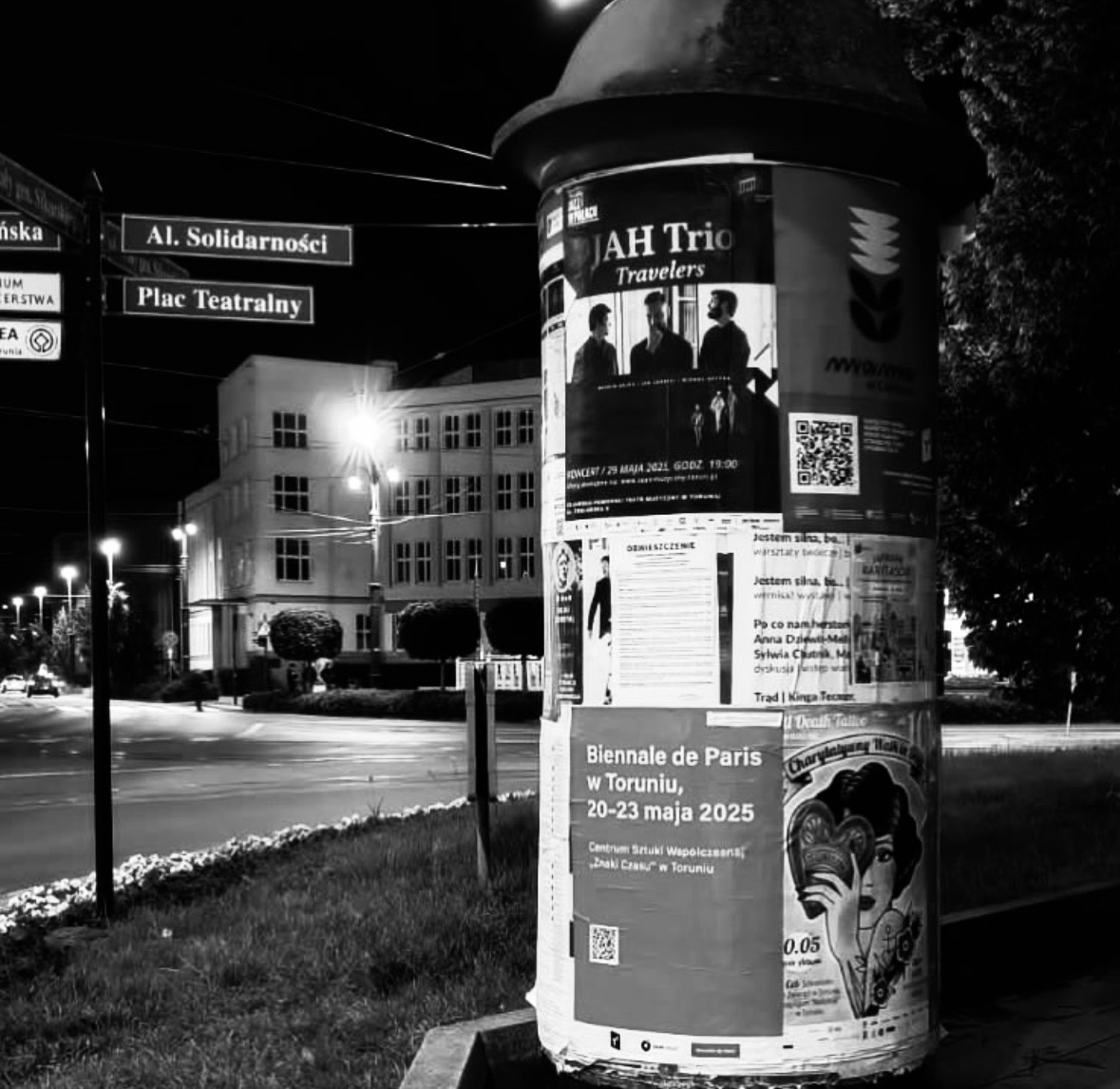
The Biennale de Paris in Poland
“Perhaps we are no longer dealing with art today. Quite simply because we missed the moment when it transformed into something completely different, something we do not know how to name. But one thing is certain: what we do today offers far greater possibilities.”
— Jerzy Ludwiński, Osieki, 1970.
The Biennale de Paris in Toruń is more than an artistic event: it is a phenomenon that redefines the very notion of art. In the city of Jerzy Ludwiński, who developed the visionary concept of the “post-artistic era,” artists and thinkers come together to develop activities rather than produce artworks.
Without exhibitions, an art market or curators, this biennale acts directly upon reality. It champions an art without objects, rich in meaning, practised here and now. Often imperceptible at first glance, this art takes forms as concrete as a demonstration, a community garden, an unconventional gathering or collective climate action.
The Biennale de Paris was founded in 1959 by André Malraux, writer and Minister of Culture, to counterbalance the Americanisation of French culture. It quickly established itself as one of Europe’s most avant-garde artistic events. Over time, its innovative approach was adopted by other art institutions. In the 1980s, a lack of funding brought it to a halt.
At the beginning of the new millennium, the Biennale de Paris was revived by artist Alexandre Gurita. It then redefined itself as a “parallel institution,” its framework shaped by artists’ approaches. It is an open platform that champions invisual art: art that exists otherwise than as an object or artwork and does not depend on being exhibited.
Just as Copernicus, born in Toruń, showed that the Earth is not the centre of the Universe, the Biennale de Paris shows that the artwork need not be the centre of art. Art can be a strategy, a relationship, a form of action and, above all, a collective process of thinking and empathy.
The Biennale de Paris in Toruń also marks an important step towards lasting cooperation between artists in Poland and France, at a time when the need for a stronger Europe built on solidarity is more pressing than ever.
Co-organised by the “Znaki Czasu” Centre of Contemporary Art and the Faculty of Fine Arts at Nicolaus Copernicus University, the event brings together diverse creative approaches to open up a space for reflection, action and dialogue, in a spirit of empathy, ecology and decolonial awareness.
The Centre of Contemporary Art in Toruń provides a welcoming setting for this gathering, grounded in freedom of expression and invisual, unconventional artistic practices. It helps activate art within society. Over four days, this gathering invites us to consider art from a radically different perspective: as a practice capable of transforming the world.
The Biennale de Paris in Toruń also hosts an academic symposium on the future of art collections, entitled “What Kind of Art Collection for the Future?”, bringing together presentations by artists and contributions from theorists.
Documents
Press kit — PDF
Programme — PDF
Contact
Email: info@biennaledeparis.fr