Umwelt Studio
Presentation

Umwelt Studio is a work by artist Franck Mas that consists of allowing an art venue to be gradually taken over by nature.
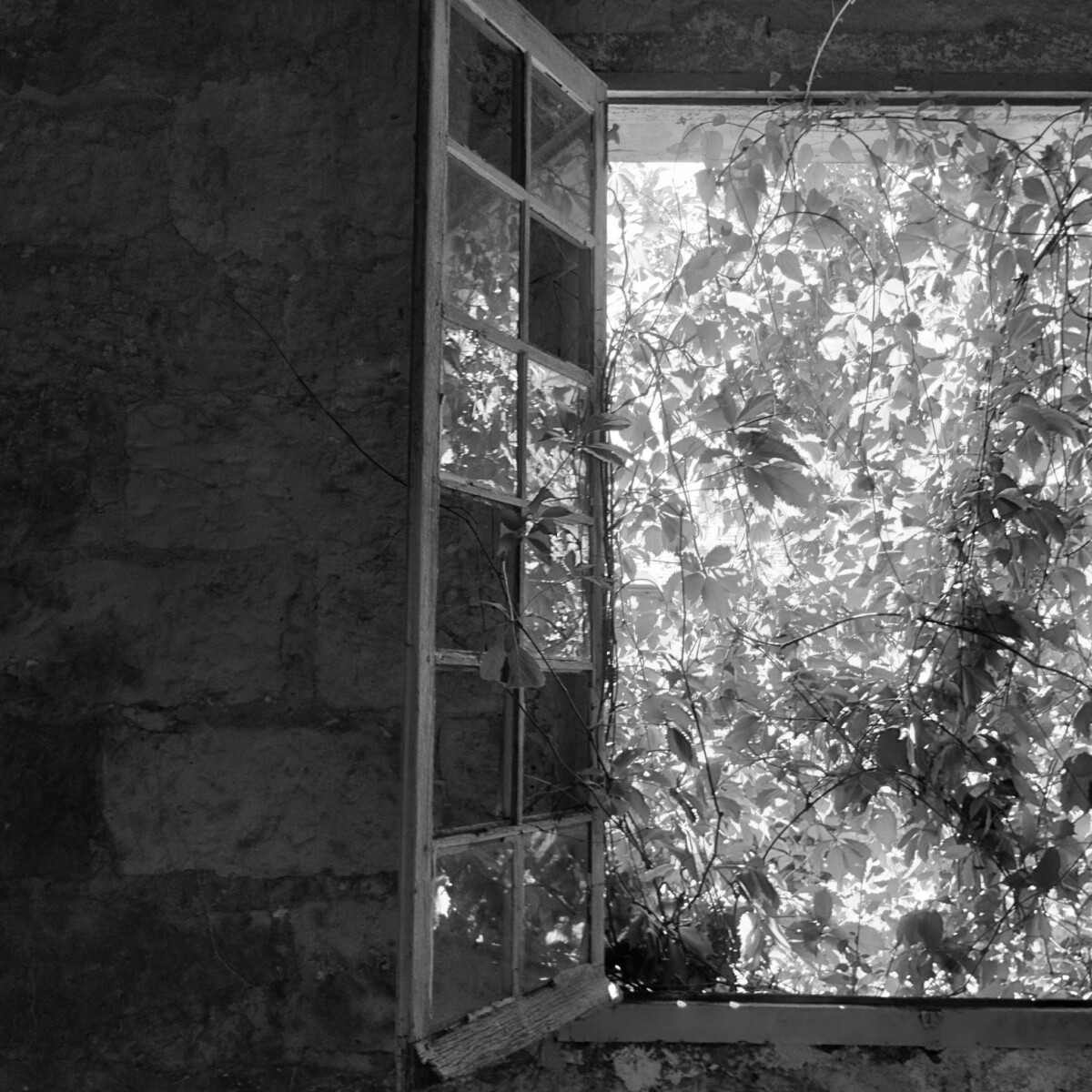
By simply leaving the doors and windows of an art centre open for a determined period of time, this process-based work transforms a building into a refuge for plant and animal life.
Through this gesture of extreme simplicity, the artist initiates a dialogue between built heritage and the organic world, cultural heritage and natural heritage, culture and nature, as well as between art and life.
His work explores notions of language, time and our relationship with the living world. By transforming an architectural heritage site into a conservatory for living beings, he shifts our perspective on the very notion of conservation.
Informed by contemporary anthropology, the work engages with the ecological concerns of our time and invites reflection on the need to build a more balanced and responsible relationship with the living world as a whole, of which human beings are only one link.
A Protocol-Based Work
Umwelt Studio is a protocol-based work, meaning a contextualised work based on a precise protocol.
The protocol is as follows:
– Leave the doors and windows of a room in a museum or art centre open, day and night, for a determined period of time.
At Les Moulins de Paillard, the protocol is applied to a small pavilion undergoing transformation, not used as an exhibition space, which gradually becomes a territory inhabited and colonised by plant and animal species.
This minimal intervention has profound consequences for our understanding of:
– the conservation mission of art institutions;
– the notion of territory;
– the relationship between the built environment and its inhabitants;
– our perception of time and duration.
The art centre thus hosts a work that is no longer an object, but a living process.
By extending its conservation mission, the institution simultaneously becomes a conservatory for living beings and a place for the conservation of a contemporary artwork.
The building no longer presents a painting, sculpture or installation: it itself becomes the work, engaged in a permanent process of evolution and transformation.
Two opposing conceptions of conservation thus coexist within the same institution: that of the museum, which protects artworks by often eliminating living organisms, and that of the living world, which finds refuge within the building.
As Gilles Deleuze and Félix Guattari write in A Thousand Plateaus, territory constitutes for the animal a genuine material of expression.
Genesis
Franck Mas states:
“As I developed this project, I drew on the work of anthropologists Tim Ingold and Philippe Descola, as well as that of philosopher and psychologist Vinciane Despret, whose writings offered complementary avenues for reflection. It was in the human sciences, more than in art history—although Paul Klee also accompanied my thinking—that I found the resources necessary for the conceptual and aesthetic development of this research. Gradually, new fields of inquiry opened up before me, allowing me to refine the work, broaden its scope and articulate more precisely what had already been present from its inception.”
Origin of the Word Umwelt
Umwelt is a German term developed in the early twentieth century by the Estonian-born biologist and philosopher Jakob von Uexküll.
Translated by Gilles Deleuze as “lived world”, it refers to the environment specific to each living being. Von Uexküll notably studied the perceptual world of the tick.
He showed that it is guided by only three pieces of sensory information:
– the smell of its host’s sweat;
– the characteristics of its skin;
– the warmth of its blood.
Its environment is entirely constituted by its perceptions and actions; no other world is accessible to it.
Franck Mas associates this notion of Umwelt with that of the Studio, understood as a place of production, experimentation and observation: a fusion between the creative studio and the vivarium devoted to the study of living organisms.
Biography
Born in 1971, Franck Mas trained as an interior architect. A graduate of the École nationale supérieure des arts appliqués et des métiers d’art, he also studied at the École nationale supérieure des Arts décoratifs (ENSAD) and pursued studies in philosophy at Université Paris-I Tolbiac. A playwright and director of opera and theatre, all of his plays have been performed, and two have been published by Éditions du Cygne.
From 2012 to 2021, he co-directed the art venue La Tannerie in Brittany. His artistic practice is based on gestures of great simplicity—writing, reading, breathing—that dissolve the boundaries between art and life.
Considering his own existence as a creative material, he develops highly economical artistic protocols on a daily basis, intended to be pursued throughout his lifetime.
His work is organised around six major cycles:
– the cycle of the sign;
– the cycle of sediments;
– the cycle of breath;
– the cycle of the Other;
– the cycle of the museum;
– the cycle of the institution.
In the latter, he explores the possibility of acting upon reality through legal and institutional mechanisms, in collaboration with researchers from the CNRS and EHESS, as well as with a notary, a lawyer and a former Member of Parliament.
Practical Information
Dates and duration:
From 24 June 2026
Location:
Les Moulins de Paillard
Lieu-dit Les Moulins de Paillard
72340 Poncé-sur-le-Loir