What Kind of Art Collection for the Future?
6 March 2015
Musée d’Art moderne de la Ville de Paris
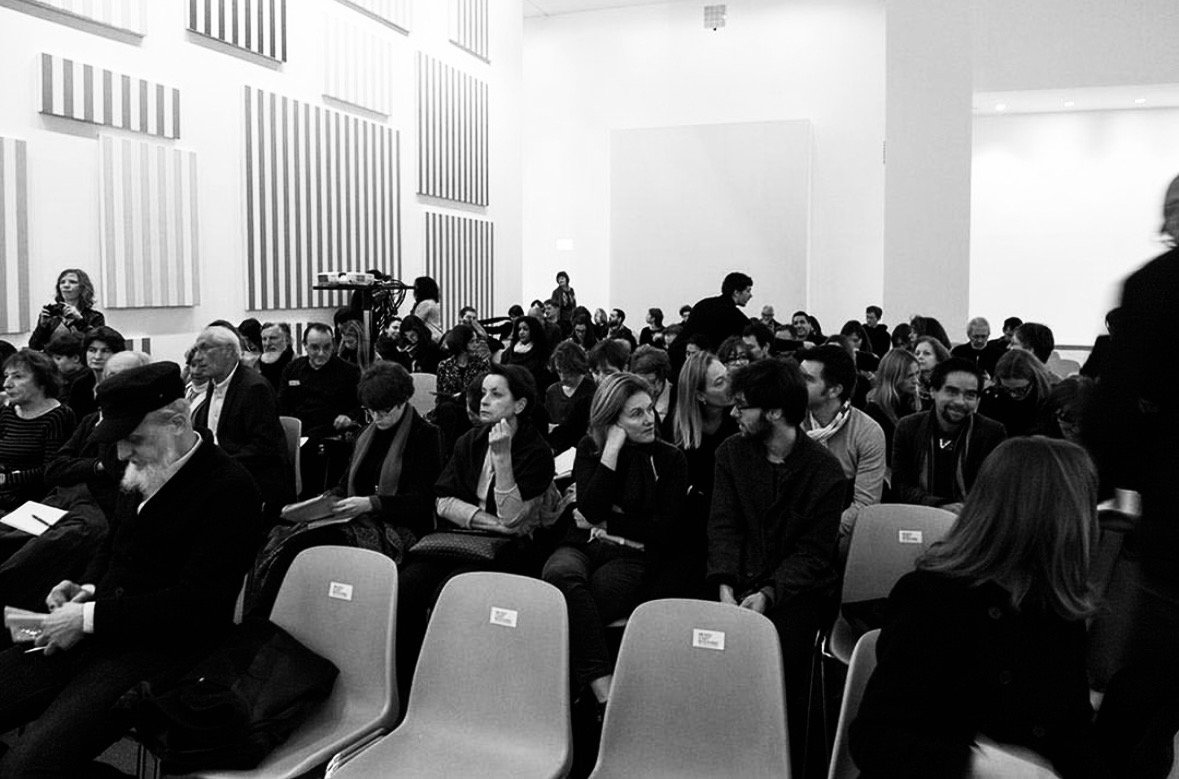
Organised by the Biennale de Paris at the Musée d’Art moderne de la Ville de Paris, this symposium follows on from a gathering organised by the Biennale de Paris at the Queens Museum of Art in New York in October 2011.
Held as part of a partnership between the Musée d’Art moderne de la Ville de Paris and the Biennale de Paris, this symposium, organised by Bérengère de Thonel d’Orgeix, explores the question of collecting and its evolution from a range of perspectives. At a time when institutions are being redefined, artistic practices are changing and becoming increasingly dematerialised, this question cannot be ignored.
Speakers: Fabrice Hergott, Bérengère de Thonel d’Orgeix, Alexandre Gurita, Bernard Blistène, Béatrice Josse, Ghislain Mollet-Viéville, Robert Storr, Alexandre Bohn, Jacques Salomon, Sébastien Faucon, Jean-Baptiste Farkas, Emma McCormick-Goodhart and Heinz-Norbert Jocks.
Programme
Opening of the Symposium
Fabrice Hergott — 10:05–10:20 a.m.
Director of the Musée d’Art moderne de la Ville de Paris
A heritage curator and art historian, Fabrice Hergott studied art history in Strasbourg after initially considering literature and Egyptology. He began a master’s degree, followed by a doctoral thesis devoted to an artist of the German avant-garde.
His career took him to the Musée d’Art moderne de Saint-Étienne before he became Director of Strasbourg’s museums from 2000 to 2006. On 13 July 2006, the Mayor of Paris, Bertrand Delanoë, announced his appointment as Director of the Musée d’Art moderne de la Ville de Paris, succeeding Suzanne Pagé, who had held the position since 1988.
The History of Art Collecting Through Its Dematerialisation: Case Studies
Bérengère de Thonel d’Orgeix — 10:20–10:40 a.m.
Biennale de Paris Project Coordinator for the Symposium
Transformations in art have challenged the development, formation and very idea of the art collection. Through certain works, artists themselves have changed the ways in which art is collected. This presentation offers a reading of the history of art collecting and its evolution through a selection of significant examples.
A graduate of Villa Arson in Nice and ESAP – Pavillon Bosio in Monaco, Bérengère de Thonel d’Orgeix continued her studies in art history at Paris-Sorbonne University. At the time of the symposium, she is pursuing further research in museology at Sorbonne Nouvelle – Paris 3 University. Her interests include the evolution of collections and the role of museums in society, with particular attention to works that disrupt the principles of acquisition and conservation.
Decollecting
Alexandre Gurita — 10:40–11 a.m.
Artist, strategist in the art sector, Director of the Biennale de Paris and the Institut des hautes études en arts plastiques (Iheap)
To consider collecting is to approach art through its ultimate destination. Decollecting art opens up perspectives beyond those of traditional collecting, which is based on the “storage” of objects. This approach challenges notions of material value, ownership and collecting. It entails “a shift from having to being.”
But if art had to be collected at all costs, what would a collection devoted to invisual practices—which do not need artworks to exist—look like?
Alexandre Gurita defines himself as a strategist in the art sector. This position describes an artist who dispenses with art objects or artworks and uses strategies to change the idea of art. Rather than limiting himself to linear reasoning, he takes into account the environment within which he operates.
He works under the identity of the Biennale de Paris, of which he is Director. It can be described as a “parallel, underground and outlaw art world.” It identifies and champions invisual practices. The invisual is not the opposite of the visual: it is visible, but not as art. Invisual practices therefore manifest themselves otherwise than as images, artworks or art objects.
Collecting in the Age of Globalisation
Bernard Blistène — 11–11:20 a.m.
Professor, curator and Director of the Musée national d’art moderne – Centre Pompidou
Appointed Director of the Musée national d’art moderne by Aurélie Filippetti, Bernard Blistène has held several positions at the Centre Pompidou. Recruited in 1983, he organised the first major exhibitions there of Christian Boltanski, Ed Ruscha and François Morellet.
After six years as Director of Marseille’s museums, he returned to the Centre Pompidou in 1996 as Deputy Director. Appointed Inspector General for Artistic Creation at the Ministry of Culture in 2002, he notably contributed to the development of the Palais de Tokyo and conceived numerous major exhibitions, including the Daniel Buren retrospective in 2002 and events marking the twentieth anniversary of the Frac collections.
Returning to the Centre Pompidou in 2009, he took charge of cultural development and created the Nouveau Festival, bringing together contemporary art, performance, literature and dance.
Working with Uncertainty
Béatrice Josse — 11:20–11:40 a.m.
Director of the Fonds régional d’art contemporain de Lorraine, Metz
The invisible, performative and protocol-based works acquired by Frac Lorraine, often by women artists, question our presence, our “here and now.” A critical tool for confronting our inability to understand the present, this collection could be considered a vanitas, a memento mori seeking to make visible what is missing: gaps, absence, silence, the other… uncertainty.
After studying both law and art history at the École du Louvre and university, Béatrice Josse became the first Director of Frac Lorraine in 1993. Having initiated its move to 49 Nord 6 Est, she programmes exhibitions and events there around political and poetic questions.
She also develops projects involving performance and the performing arts, notably through the A Space for Live Art network, which operates in Belgium, France, the United Kingdom, Slovenia, Finland, Germany, Poland and Spain. She contributes to the programming of the Tempo Festival in Rio de Janeiro, the Santiago Biennial in Chile and Alternativa in Gdańsk.
The exchange of knowledge and attention to sensory approaches make Frac Lorraine’s programme a space for experimentation. Inviting writers, musicians, scientists, psychoanalysts, philosophers and other conveyors of ideas makes it possible to address issues such as gender, postcolonialism and ecofeminism.
An Unconventional Approach to Art Collecting
Ghislain Mollet-Viéville — 11:40 a.m.–12 noon
Art agent and consultant, art critic, honorary expert to the Paris Court of Appeal, member of the International Association of Art Critics and collector
This presentation proposes extending the notion of collecting to the social dimensions of an art that refuses to be valued as a fetishised object. It envisages a collection open to the realities of life, giving experimentation, exchange and sharing priority over exclusive ownership. In this collection of pioneering practices, art no longer hangs on gallery walls: it is activated within society and becomes secondary to the behaviours it generates.
Since 1975, Ghislain Mollet-Viéville’s agency has received visitors by appointment only, providing information on Minimal and Conceptual art, including their contemporary developments. Its aim is to involve different sectors of society in updating the ways in which works are produced, circulated, acquired and activated, where their originality calls for unprecedented principles of presentation.
For him, the art object is no longer the object of art! To champion these practices, which extend beyond conventional art venues, he pioneered the profession of art agent, expressing his interest in managing art through its relationships with society.
Since 1994, his apartment on rue Beaubourg, where he lived from 1975 to 1992, has been faithfully reconstructed at the Musée d’art moderne et contemporain in Geneva (Mamco), where it is permanently displayed with his collection of Minimal and Conceptual art.
He also presents the certificates, warnings, recordings, technical specifications, powers of attorney and protocols used in contemporary art. These documents question art’s material and intellectual status and allow works to be interpreted according to a particular time and place.
Questions and Answers
12 noon–12:30 p.m.
Break
12:30–2 p.m.
How Can the Ephemeral Be Collected?
Robert Storr — 2–2:10 p.m.
Writer, artist, art critic, curator at the Museum of Modern Art and Dean of the Yale University School of Art
“What artists do today is so varied and so widely dispersed that it is truly futile to concern ourselves, as we once did, with a single major artistic trend. If, like me, you think of art as a vast estuary made up of many channels of different widths, depths and flow rates, the conclusion is that we should not follow only the widest and fastest channels. We must also explore the narrower and slower ones, sometimes the deepest, or those that take surprising and mysterious directions. Since there are many ways to map such a space but no way to traverse it in its entirety, my strategy has been to try to follow one current after another, in a way that offers a sense of the whole landscape while focusing my attention on particular areas. I simply no longer accept the idea that there is a mainstream circuit of art. Important and influential art is being made everywhere today, as it has been for a long time. It is increasingly unnecessary for artists to live in the artistic ghettos of one or another of the most active cities. The avant-garde is not a style or a trademark; it is an attitude deliberately adopted by a certain segment of artists and art critics.”
Dean of the Yale University School of Art since 2006, Robert Storr organised the fifth SITE Santa Fe international biennial, Disparities and Deformations, in 2004–2005. In 2007, he became the first American to direct the Venice Biennale, whose 52nd International Art Exhibition was entitled Think with the Senses — Feel with the Mind. Art in the Present Tense.
In 2002, he became the first holder of the Rosalie Solow Chair in Modern Art at New York University’s Institute of Fine Arts. He previously served as a curator in the Department of Painting and Sculpture at MoMA in New York from 1990 to 2002.
Preserving and Circulating
Alexandre Bohn — 2:10–2:30 p.m.
Director of the Fonds régional d’art contemporain de Poitou-Charentes
The regional contemporary art collections (Frac) collect in order to circulate art. Each initiative to bring works to audiences is a human adventure. Among those involved in circulating art, the Frac stand out for the intensity and diversity of their mediation activities, supporting both the works and the people who make up their audiences.
This contribution to the reach of artistic approaches, combined with sustained attention to emerging creation, equips the Frac to engage with conceptual works rooted in the social sphere. Through their actions, they contribute to thinking about art as social activism, questioning both the validity of the art object and the purpose of collecting it.
After studying art history at the École du Louvre, Alexandre Bohn worked as an art critic from 1991 to 2006. His texts appeared in catalogues and in Revue Noire, Le Journal des Expositions and Mouvement. A lecturer within the cultural department of the Galerie nationale du Jeu de Paume, he also served as visual arts adviser to the Meuse departmental council. He has directed Frac Poitou-Charentes since September 2007.
Within the acquisition advisory committees, he draws in particular on the expertise of Yann Chevalier, Julie Crenn, Frank Lamy, Enrico Lunghi and Stephen Wright. This collaboration enables the Frac to acquire works that combine reflection on the indeterminate status of the artist and artwork with social critique. They thus question the nature and future of the cultural constructs that are the collection and the exhibition.
The collection includes works by Marcel Duchamp, the agency les ready-made appartiennent à tout le monde® and Martin Tupper — Show Room, Collection Yoon Ja et Paul Devautour. It has also expanded to include works by Karen Andreassian, Édouard Boyer, Émilie Perotto, Bernard Brunon / That’s Painting Productions and Ludovic Chemarin©.
The Collector’s Responsibilities Towards the Artwork
Jacques Salomon — 2:30–2:50 p.m.
Collector
Three works serve as examples:
- This is New by Tino Sehgal, 2003, in which the collector addresses those around them.
- La Pétition de Principe by Philippe Thomas, 1988, for which the collector creates a new visitors’ book each time the work is exhibited.
- Sing Like Baldessari (Freestyle) by Mario García Torres, 2004, which the collector presented as a karaoke event in Zurich in April 2008.
Myriam and Jacques Salomon have been interested in Minimal and Conceptual art since the late 1960s and the 1970s. They personally knew the innovative artists of this pivotal period in art history.
They continued to build their collection by acquiring artworks, photographs, videos and installations exploring language, the gaze, commentary on art history and the artist’s identity.
Their interest subsequently turned towards approaches that, notably following Philippe Thomas, question the relationships between art and society, the figure of the artist as entrepreneur, the conception and implementation of protocols, and immaterial art, thereby challenging traditional artistic forms.
Collecting the Living
Sébastien Faucon — 2:50–3:10 p.m.
Inspector for Artistic Creation, Head of Contemporary Collections at the Centre national des arts plastiques
Attentive to the full range of contemporary practices, the collection of the Centre national des arts plastiques (Cnap) has naturally incorporated, through acquisitions and commissions, practices involving the performing arts, performance, protocols and the immaterial.
Without excluding more traditional forms of creation, the collection has expanded. It must now fundamentally renew its approach to the artwork, from reactivation to archiving.
Sébastien Faucon has been Head of Contemporary Collections at Cnap since 2009. After studying history and art history, he worked at the Musée national d’art moderne – Centre Pompidou from 2003 to 2006, then at the Ministry of Culture and Communication as visual arts adviser at Drac Lorraine from 2006 to 2008.
His research focuses particularly on transdisciplinary approaches linking the visual arts with live forms, especially sound and performance. He notably curated Diagonales: Sound, Vibration and Music in 2010 and the exhibition Collector at the Tripostal in Lille in 2011.
He also contributed to La Permanence, conducted throughout 2014 at the Musée de la danse in Rennes with Boris Charmatz; the performative exhibition Des choses en moins, des choses en plus at the Palais de Tokyo with Agnès Violeau; and the exhibition Laisser les sons aller où ils vont at Frac Franche-Comté.
IKHÉA©SERVICES & Glitch in Collections: From Storage to Action!
Jean-Baptiste Farkas — 3:10–3:30 p.m.
Artist
“I believe that:
- the art object clutters our lives and has become superfluous;
- the present calls on us to give full importance to the act of subtraction;
- our conception of authorship, based on the idea that there is a single author behind each work, is an illusion—a convenient shortcut that we must now revisit;
- the exhibition is an outdated format that must make way for other modes of action, such as the manoeuvre or the operation.”
IKHÉA©SERVICES and Glitch services, such as Atelier H.S., L’annulation d’espaces, Ceinture!, Perdre son temps and Slowmo, belong to public or private collections. How do these services operate within such frameworks, and what unprecedented possibilities do they open up within collections?
For Jean-Baptiste Farkas, artistic practice must question the notions of artist, artwork and presentation venue. His activity consists of proposing instructions to be put into practice, where an artist would ordinarily be expected to deliver a finished, exhibited work.
Through his services, he invites everyone to carry out specific tasks in which the principle of efficiency is reversed: rendering part of a dwelling unusable, slowing the pace of work or lying.
These services belong neither to performance nor to happenings, nor to what is commonly called “participatory art” or “relational art.” Structured around the notions of use and service provision, they seek to engage with everyday reality and raise questions about behavioural as well as artistic norms.
According to Jean-Baptiste Farkas, acting and “operating in the real world” requires shedding anything that might resemble stylistic effects, allowing the work to disperse and infiltrate places where it is least expected.
A Shift Towards Orality
Emma McCormick-Goodhart — 3:30–3:50 p.m.
Artist
Emma McCormick-Goodhart carried out a service by Jean-Baptiste Farkas that she had acquired. This approach considers orality as a possible space for future collections, in relation to Tino Sehgal’s works, UbuWeb’s radio practices and other ecological models.
A Paris-based artist, Emma McCormick-Goodhart explores the voice and its modes of expression through radio broadcasting and the staging of performative lectures.
A Typology of the Collector
Heinz-Norbert Jocks — 3:50–4:10 p.m.
Journalist, author, art critic and curator
Who creates art history? To explore this question, Heinz-Norbert Jocks met collectors in London, Berlin, Hamburg, Tel Aviv, Montevideo, Paris and Beijing.
Why do people buy artworks? Who contributes to writing art history? Is it possible to establish a typology of collectors?
Born in Düsseldorf, Heinz-Norbert Jocks studied philosophy and German literature. An author, curator and correspondent for Kunstforum International, he has also edited thematic issues devoted, among other subjects, to Beijing and the power of collectors. He is one of the four founders of The Collective Eye.
Questions and Answers
4:10–4:40 p.m.
Related Link
What Kind of Art Collection for the Future? — Musée d’Art moderne de la Ville de Paris